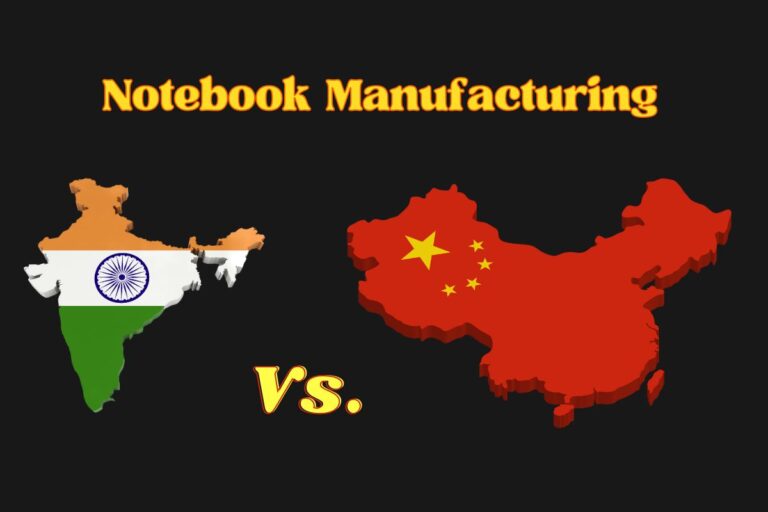
If you’re sourcing notebooks for your wholesale business, you’ve probably asked yourself this question: Should I buy from India or China? It’s a decision that can significantly impact your profit margins, product quality, and supply chain reliability.
As a notebook manufacturer in India working with importers across 34+ countries, I’ve watched this conversation evolve dramatically over the past decade. The answer isn’t as simple as it once was. Let me share what I’ve learned from years of real-world experience in the wholesale notebook industry.
The Changing Landscape of Global Notebook Sourcing
For decades, China dominated the global stationery manufacturing scene. Their massive production capacity, established supply chains, and competitive pricing made them the default choice for most importers. But the landscape is shifting.
India’s stationery market has grown at an impressive 6-7% annually, mirroring GDP growth. The paper stationery segment alone is valued at approximately ₹16,200 crore and projected to reach ₹28,700 crore by 2030. This growth isn’t happening in isolation—it’s driven by real advantages that smart importers are recognizing.
The “China Plus One” strategy has become more than a buzzword. It’s a practical approach that importers use to reduce supply chain risks. And when it comes to exercise books, spiral notebooks, and journals, India offers compelling reasons to diversify.
Cost Comparison: Breaking Down the Numbers
Let’s address the elephant in the room—pricing. Yes, China often offers lower initial quotes. But the complete cost picture tells a different story.
Labor costs in India are significantly lower than China. Average monthly wages for factory workers in India range between $150 and $300, compared to over $600 in many Chinese industrial zones. For labor-intensive products like notebooks, this creates meaningful savings.
But raw cost isn’t everything. Indian manufacturers, particularly those based in Delhi-NCR like Sarbazo Group, benefit from proximity to domestic paper mills. This reduces raw material costs and ensures consistent quality control. We source high-quality paper locally, which means fewer supply chain disruptions and more predictable pricing.
Operational expenses also favor India. Utilities, factory rental costs, and logistics expenses tend to be more economical, especially in established industrial hubs. When you factor in currency exchange rates—the Indian Rupee often provides favorable conversion for USD and EUR buyers—the value proposition becomes clearer.
Quality Standards: What Really Matters
Quality concerns top the list of pain points for international notebook importers. Inconsistent paper GSM, weak binding, and poor finishing have plagued many sourcing relationships—regardless of country.
Here’s what differentiates quality-focused Indian manufacturers:
Paper Quality: India has a robust paper manufacturing ecosystem with over 850 mills. Quality-conscious manufacturers work with certified suppliers to ensure consistent brightness, texture, and GSM across batches. At Sarbazo Group, we implement three-stage quality control—raw material inspection, in-process checks, and pre-shipment verification.
Binding Strength: Whether it’s stitched exercise books, spiral-bound notebooks, or perfect-bound journals, binding durability is non-negotiable. Indian manufacturers with proper quality systems match or exceed Chinese counterparts in binding strength.
Sustainability Credentials: This is where India increasingly outperforms. FSC certification, recycled paper options, and eco-friendly manufacturing practices are becoming standard among export-focused Indian suppliers. Many developed markets now require these certifications—Indian manufacturers are well-prepared to comply.
Communication and Cultural Alignment
This advantage doesn’t show up in spreadsheets, but it dramatically impacts your sourcing experience.
English proficiency in India’s business community is exceptional. You can communicate complex specifications, negotiate terms, and resolve issues without translation barriers. Time zone alignment also helps—India overlaps reasonably with both European and African business hours, enabling real-time communication.
Cultural understanding matters too. Indian manufacturers often demonstrate greater familiarity with Western and African market preferences. We understand what works for school supplies in Ghana, office stationery in the UAE, or premium journals for European retailers. This cultural intelligence translates into better product recommendations and fewer costly misunderstandings.
Customization Capabilities: Where India Excels
If you’re looking for custom notebook manufacturing, India offers distinct advantages.
Indian manufacturers typically demonstrate greater flexibility with smaller minimum order quantities. While Chinese factories often require massive volumes to justify customization, Indian suppliers work with growing importers who need flexibility.
OEM and ODM services are well-developed. Whether you need custom cover designs, specific ruling patterns, branded diaries, or unique binding styles, Indian manufacturers accommodate diverse requirements. This flexibility helps importers differentiate their products in competitive markets.
Turnaround times for samples and prototypes are often faster from India. When you’re developing new product lines or responding to market trends, this speed matters.
Logistics and Shipping Realities
Let’s be honest about infrastructure. China maintains world-class highways, ports, and logistics systems. India has made significant progress—projects like the Delhi-Mumbai Industrial Corridor and Sagarmala have improved port connectivity—but challenges remain in some areas.
However, for notebook importers, the practical impact is manageable. Major manufacturing hubs like Delhi-NCR have excellent access to international shipping. Manufacturers experienced in export handle documentation, customs, and freight forwarding efficiently.
Shipping costs from India often compare favorably to China, particularly for destinations in Africa, the Middle East, and Europe. India’s strategic location provides natural advantages for these markets.
Supply Chain Resilience: The Hidden Advantage
The COVID-19 pandemic taught importers a painful lesson about supply chain concentration. Relying entirely on one country—regardless of which country—creates unacceptable risk.
Diversifying your notebook supplier base between India and China provides genuine resilience. When production disruptions, shipping delays, or trade tensions affect one source, you maintain continuity from the other.
India’s improving ease of doing business ranking—from 142nd in 2015 to 63rd in 2020—reflects real reforms. Government initiatives like “Make in India” and Production-Linked Incentive schemes are attracting manufacturing investment and improving operational predictability.
Certifications and Compliance
International importers face increasing regulatory requirements. Your suppliers must provide proper documentation for customs clearance and market compliance.
Indian manufacturers serving export markets maintain necessary certifications including FSC for responsible forestry, ISO 9001 for quality management, and compliance with REACH and other material safety standards.
Documentation practices in India’s organized manufacturing sector are thorough. Export documents—commercial invoices, packing lists, bills of lading, certificates of origin—are prepared accurately and submitted on time. This attention to paperwork prevents costly customs delays in destination countries.
When to Choose India vs China
Based on experience working with importers across diverse markets, here’s practical guidance:
Consider India when: You prioritize communication ease and responsive service. Your target markets are in Africa, Middle East, or Europe. You need FSC certification or sustainable products. You want customization flexibility without massive MOQs. You’re building long-term supplier relationships rather than one-time purchases. You value IP protection and transparent business practices.
Consider China when: You need extremely high volumes with maximum cost optimization. Your products require sophisticated automation or technology integration. Your existing supply chain is already heavily invested in Chinese logistics. You’re sourcing for markets where China has established shipping advantages.
Consider both when: You’re serious about supply chain resilience. You want to compare actual samples and pricing from competing sources. You’re growing and need flexibility to scale with different suppliers.
Making Your Decision: Practical Next Steps
Whether you’re new to importing notebooks or looking to diversify your existing supply chain, here’s how to move forward:
Request samples: Nothing beats evaluating physical products. Test paper quality, binding strength, and finishing yourself. Compare samples from both Indian and Chinese suppliers side by side.
Verify certifications: Ask for FSC certificates, quality management documentation, and export credentials. Legitimate manufacturers provide these readily.
Start with trial orders: Before committing to large volumes, place smaller orders to test communication, quality consistency, and delivery reliability.
Visit facilities when possible: For significant partnerships, factory visits provide invaluable insight into actual capabilities and working conditions.
Building a Partnership That Works
At Sarbazo Group, we’ve built our notebook manufacturing business on transparency, quality, and genuine partnership. We don’t just process orders—we help importers solve business challenges.
Whether you’re exploring India as an alternative to China or looking to add a reliable Indian supplier to your existing network, the opportunity is real. India’s notebook manufacturing industry has matured to meet international standards while offering advantages that experienced importers increasingly recognize.
The best sourcing decision isn’t about choosing one country over another. It’s about finding the right partners who understand your market, meet your quality standards, and support your business growth.
Ready to explore what Indian notebook manufacturing can offer? Contact us for samples and pricing. Let’s start a conversation about your specific requirements.