
Last week, a Kenya importer called me frustrated. His customers were returning notebooks with complaints about “see-through paper” and “ink bleeding.” After reviewing samples, the problem was obvious: he’d ordered 60 GSM paper when his market needed 70 GSM.
This single specification mistake cost him thousands in returns and damaged his reputation with retailers.
If you’re importing notebooks and don’t fully understand notebook paper GSM, you’re risking the same expensive mistake. Paper GSM directly affects product quality, customer satisfaction, pricing, and your profit margins.
In this guide, I’ll explain everything you need to know about paper GSM for notebooks—from basic definitions to practical selection criteria for different markets. You’ll learn exactly which GSM specifications protect your business and build your reputation.
What is GSM? The Simple Definition
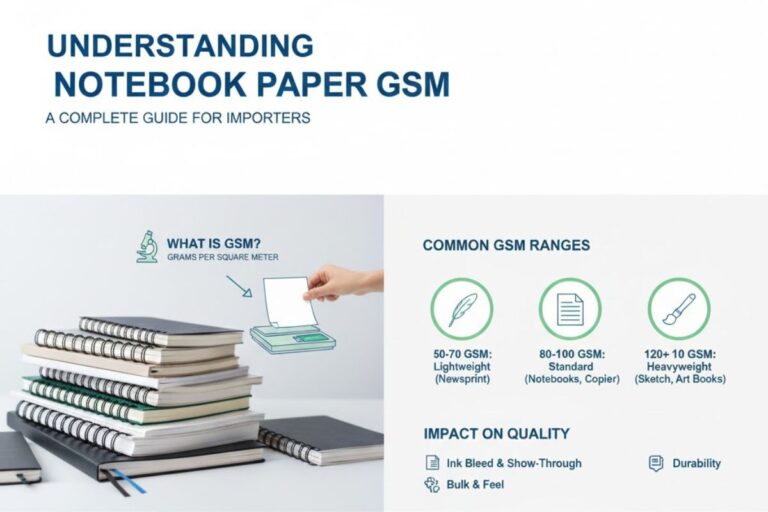
GSM stands for “Grams per Square Meter”—it measures paper weight and thickness. Specifically, GSM tells you how much one square meter of paper weighs in grams.
Simple examples:
- 60 GSM paper: One square meter weighs 60 grams
- 70 GSM paper: One square meter weighs 70 grams
- 80 GSM paper: One square meter weighs 80 grams
Higher GSM = heavier paper = thicker paper = higher quality (generally).
Why GSM Matters for Quality
GSM directly affects four critical factors:
1. Opacity (See-Through Prevention)
- 60 GSM: Noticeable see-through with most pens
- 70 GSM: Minimal see-through with ballpoint pens
- 80 GSM: Excellent opacity, no see-through
2. Ink Bleed-Through Resistance
- 60 GSM: Can bleed with gel pens or fountain pens
- 70 GSM: Resists bleeding with most common pens
- 80 GSM: Excellent resistance to all writing instruments
3. Durability and Feel
- 60 GSM: Feels thin, tears more easily
- 70 GSM: Balanced feel, adequate durability
- 80 GSM: Premium feel, high durability
4. Customer Perception
Customers physically feel paper quality when picking up notebooks. Thicker paper creates immediate impression of higher quality—and justifies higher prices.
Common GSM Ranges for Notebooks
60 GSM Paper: Economy Grade
Characteristics:
- ✓ Lightweight and economical
- ✓ Noticeable see-through
- ❌ Can show ink bleed with gel pens
- ❌ Thinner feel, less premium perception
Best use cases: Budget exercise books for price-sensitive markets, rough work notebooks, high-volume government tenders with strict budgets.
Markets where 60 GSM works: Some African countries with very price-sensitive budgets, entry-level stationery, promotional notebooks.
Cost advantage: 15-20% cheaper than 70 GSM
⚠️ Warning: If your market expects quality, 60 GSM will damage your reputation. Customer complaints about see-through and bleeding are common.
70 GSM Paper: Standard Quality (Most Common)
Characteristics:
- ✓ Good balance of quality and cost
- ✓ Minimal see-through with ballpoint pens
- ✓ Resists ink bleeding
- ✓ Adequate durability for school use
Best use cases: Standard school exercise books, general-purpose notebooks, corporate meeting notebooks, spiral notebooks for students.
Markets where 70 GSM dominates: Most African education markets (Ghana, Kenya, Nigeria, Tanzania), Middle East school supplies, India domestic standard, Latin American educational sector.
✓ Recommendation: If you’re unsure which GSM to choose, 70 GSM is the safe middle ground that satisfies most markets without premium costs.
80 GSM Paper: Premium Grade
Characteristics:
- ✓ Premium quality with excellent opacity
- ✓ No see-through with any writing instrument
- ✓ Superior ink bleed resistance
- ✓ Premium feel justifies higher pricing
Best use cases: Premium journals and diaries, executive notebooks, high-quality student planners, artist sketchbooks, corporate branded notebooks.
Markets where 80 GSM expected: European retail markets (UK, France, Germany), North American premium segment, Middle East corporate gifting, premium retail chains globally.
Cost premium: 12-15% higher than 70 GSM
✓ Opportunity: 80 GSM allows you to position products in premium segments with 25-40% higher retail margins.
How to Choose the Right GSM for Your Market
Factor 1: Market Expectations
African Markets:
- Standard: 70 GSM
- Premium: 80 GSM
- Trend: Gradually moving toward 70 GSM as minimum
Middle East Markets:
- Standard: 70-80 GSM
- Premium/Corporate: 80-100 GSM
- Trend: Strong preference for premium quality
European Markets:
- Standard: 80 GSM minimum
- Premium: 90-120 GSM
- Trend: Quality and sustainability emphasized
Latin American Markets:
- Standard: 70 GSM
- Premium: 80 GSM
- Trend: Price remains important factor
Factor 2: Product Type and End Use
Exercise Books (School Use):
- Primary school: 70 GSM
- Secondary school: 70-80 GSM
- University/College: 80 GSM
Check out our exercise books with different GSM options designed for educational markets.
Spiral Notebooks:
- Student use: 70 GSM minimum
- Professional use: 80 GSM
- Art/Design: 90-120 GSM
Why higher GSM for spiral? Spiral binding creates stress on pages. Thicker paper resists tearing at binding.
Journals and Diaries:
- Standard journals: 70-80 GSM
- Premium journals: 80-100 GSM
- Executive diaries: 80-90 GSM
Factor 3: Writing Instrument Compatibility
Ballpoint Pens (Most Common):
- Minimum: 60 GSM (acceptable)
- Recommended: 70 GSM (good experience)
- Premium: 80 GSM (excellent)
Gel Pens (Popular with Students):
- Minimum: 70 GSM (prevents bleeding)
- Recommended: 80 GSM (reliable performance)
Fountain Pens (Office/Premium Use):
- Minimum: 80 GSM
- Recommended: 90 GSM
Factor 4: Price Positioning and Margins
Cost impact example (100-page A4 exercise book):
- 60 GSM: Manufacturing $0.45 → Wholesale $0.60 → Retail $1.00
- 70 GSM: Manufacturing $0.52 → Wholesale $0.75 → Retail $1.25
- 80 GSM: Manufacturing $0.60 → Wholesale $0.95 → Retail $1.75
Margin analysis:
- Budget strategy (60 GSM): Lower margins, volume dependent, quality complaints risk
- Standard strategy (70 GSM): Balanced margins, acceptable quality, safe middle ground
- Premium strategy (80 GSM): Higher margins justify lower volume, quality builds brand value
Real example: UAE importer switched from 70 GSM to 80 GSM for corporate diaries. Despite 15% higher costs, achieved 35% higher selling prices and 60% improved margins.
How to Verify GSM Quality
Physical Testing (Most Reliable)
Steps:
- Request samples from potential suppliers
- Cut exactly 10cm x 10cm square (0.01 square meters)
- Weigh on precision scale (±0.01 gram accuracy)
- Multiply weight by 100 to get GSM
Example: If square weighs 0.70 grams → 0.70 × 100 = 70 GSM ✓
Practical Quality Tests
Opacity test:
- Write on one side with ballpoint pen
- Turn page over
- Check if writing shows through
- Heavy show-through: Likely 60 GSM or lower
- Slight shadow: Likely 65-70 GSM
- No show-through: Likely 75-80 GSM
Request Certification
Professional suppliers provide:
- ✓ Paper mill certificates showing GSM specifications
- ✓ Third-party laboratory test reports
- ✓ Batch testing documentation
As part of our quality control process, we verify GSM at raw material stage before production begins.
Sample Approval Process
Always approve physical samples before production:
- Request samples of specified GSM
- Test samples with actual writing instruments your customers use
- Have end-users test samples if possible
- Verify GSM matches specifications
- Approve sample in writing before production
Common GSM Mistakes Importers Make
Mistake 1: Choosing GSM Based Only on Price
Real example: Importer saved $0.05 per notebook using 60 GSM instead of 70 GSM. After 15% return rate due to quality complaints, he lost $3,000 on a $10,000 order. The “savings” cost him far more.
Solution: Choose GSM based on market quality expectations, not just lowest cost.
Mistake 2: Not Testing with Actual Pens
Real example: Importer approved 70 GSM samples tested with ballpoint pens. Customers used gel pens—ink bled through. $8,000 worth of notebooks sat unsold.
Solution: Test samples with exact writing instruments your market uses.
Mistake 3: Assuming All 70 GSM Paper is Equal
Two 70 GSM papers can perform differently based on:
- Paper pulp quality (virgin vs recycled)
- Manufacturing process
- Brightness level
- Density and consistency
Solution: Evaluate complete paper specifications, not just GSM number. Consider FSC certified paper for quality assurance.
Mistake 4: Not Accounting for GSM in Pricing Strategy
Lost opportunity: Selling 80 GSM at same price as 70 GSM competition leaves money on the table.
Solution: Position higher GSM as premium products with appropriate pricing. Educate customers on quality differences.
Cost-Benefit Analysis: 70 GSM vs 80 GSM
Scenario: 50,000 notebooks, Middle East market
70 GSM Option:
- Total cost: $26,000
- Wholesale price: $0.75
- Margin per unit: $0.23 (44%)
- Return rate: 3%
- Net profit: $10,720
80 GSM Option:
- Total cost: $30,000
- Wholesale price: $0.95 (premium positioning)
- Margin per unit: $0.35 (58%)
- Return rate: 1%
- Net profit: $17,200
Result: Additional $4,000 investment delivers $6,480 additional profit (162% ROI on quality upgrade).
Conclusion: GSM is a Strategic Decision
Understanding notebook paper GSM is essential for importing success. The right GSM choice protects your business, builds customer loyalty, and enables premium positioning.
Key takeaways:
- ✓ GSM directly affects quality: opacity, bleed resistance, durability, customer perception
- ✓ Different markets have different expectations: match GSM to local standards
- ✓ 70 GSM is the global standard: safe middle ground for most applications
- ✓ 80 GSM enables premium positioning: higher margins justify the investment
- ✓ Always verify GSM: test samples before production
- ✓ Match GSM to writing instruments: test with pens customers actually use
Your Action Plan
Step 1: Identify your market requirements—research quality expectations in your target market
Step 2: Define your GSM strategy—decide if you’ll compete on price (lower GSM) or quality (higher GSM)
Step 3: Request paper samples in your target GSM ranges and test with actual writing instruments
Step 4: Approve specifications in writing—document exact GSM requirements in purchase order
Step 5: Position products correctly—educate customers about GSM quality differences and price accordingly
Partner with Quality-Focused Manufacturers
Look for manufacturers who provide GSM certification, conduct in-process testing, welcome inspections, and offer multiple GSM options.
At Sarbazo Group, paper quality verification is part of our three-stage QC system. We test GSM at raw material stage, during production, and before shipment. Our complete range of notebooks includes multiple GSM options designed for different international markets.
Whether you’re sourcing 70 GSM exercise books for African schools or 80 GSM premium journals for European retail, understanding GSM ensures you deliver quality that builds your reputation and drives profitable growth.
Ready to discuss the right GSM specifications for your market? Contact us to receive samples and expert guidance on selecting optimal paper specifications for your target customers.
Choose GSM wisely—it’s the foundation of notebook quality that determines your success.